

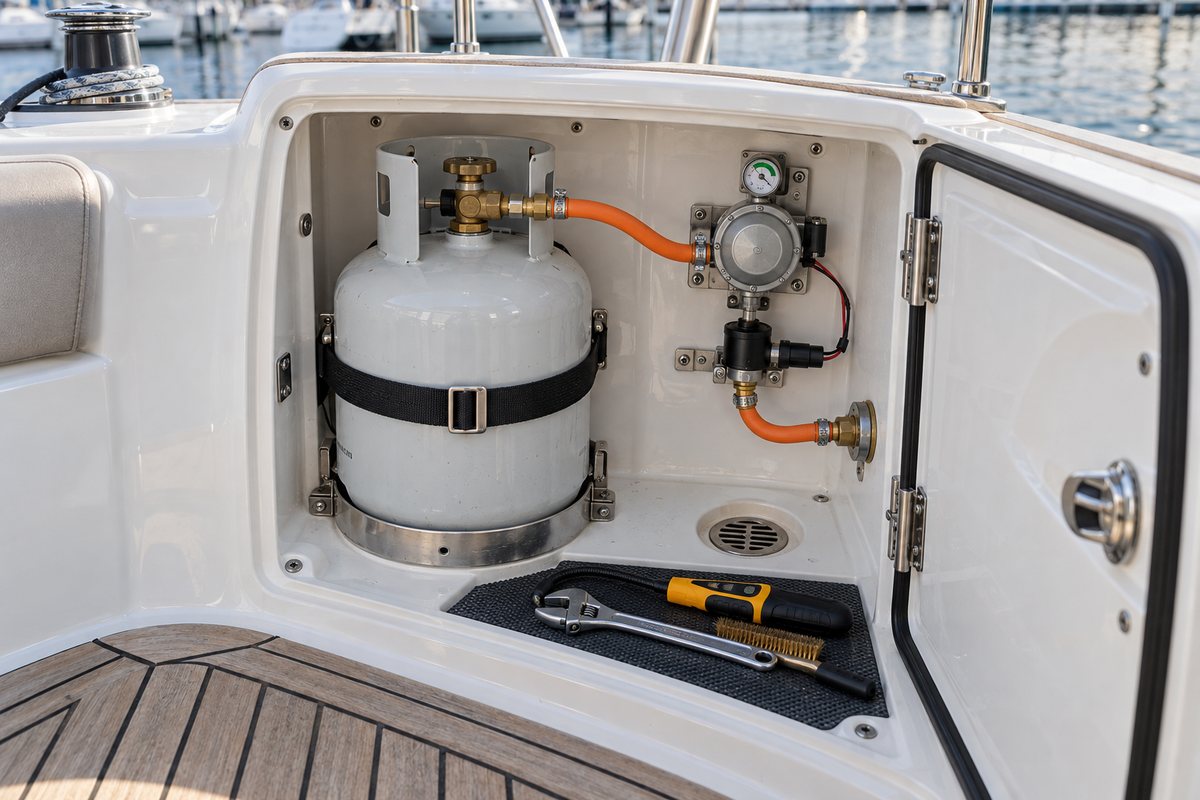
An installed marine LPG system makes cooking and cabin heat convenient, but propane deserves a disciplined inspection before winter storage. Leaking propane is heavier than air, so it can settle in low spaces instead of dispersing like a light vapor. That is why a boat's cylinder locker, overboard drain, regulator, shutoff solenoid, hose, appliance connection, and gas detector should be treated as one safety system—not as unrelated parts.
This guide applies only to boats with permanently installed liquefied petroleum gas (LPG, commonly propane) equipment. It is not a substitute for the boat, appliance, regulator, detector, or cylinder manufacturer's instructions. Do not improvise fittings, pressure settings, wiring, or leak-test procedures. If the installation is unfamiliar, damaged, altered, or fails a test, close the cylinder valve, keep ignition sources off, ventilate safely, and have a qualified marine LPG technician correct it.
Why inspect the marine propane system before layup?
End-of-season access is useful because lockers are often emptied, the boat is stationary, and corrosion, chafe, loose mounting, and water intrusion are easier to see. A careful inspection can identify deterioration before storage moisture and freezing conditions make it worse.
Transport Canada's Safe Boating Guide explains the central risk: leaking propane and butane vapors are heavier than air and can flow into lower parts of a boat. The guide recommends marine-designed equipment, qualified installation and service, secure cylinders in ventilated areas, and ignition-protected electrical devices where propane vapor may be present. Those principles should shape every inspection decision.
Start by identifying the exact system
Before opening the locker, find the documentation for the boat and every installed LPG component. Record:
- Cylinder type, capacity, identification markings, and applicable requalification date
- Regulator manufacturer and model
- Solenoid valve manufacturer, voltage, and fuse or breaker location
- Hose or tubing type and any marked manufacturing or replacement information
- Appliance manufacturer and model
- LPG detector model, sensor location, and replacement or end-of-life guidance
- Normal operating and shutdown procedure
Do not assume two boats use the same pressure, fittings, detector behavior, or storage procedure. A factory installation may also have been modified by a previous owner. If the actual routing differs from the drawings or the components do not match the records, treat that mismatch as a reason for professional evaluation.
Make the boat safe before touching anything
Work in daylight with good ventilation. Extinguish flames and smoking materials, and do not operate switches or equipment that could create a spark if you smell gas. Close the cylinder valve according to the system instructions and allow appliances to cool. De-energize the LPG solenoid circuit before inspecting its wiring or terminals.
Never search for a leak with a flame. Use only the method and solution approved by the component manufacturer, or have a qualified technician conduct the test. If there is any propane odor, hissing, detector alarm, or unexplained pressure loss, stop and isolate the supply rather than continuing a routine checklist.
Inspect the LPG cylinder and restraint
The cylinder should remain upright and firmly restrained so normal boat motion cannot strain the valve, regulator, or hose. Look for deep corrosion, dents, gouges, heat damage, a bent valve guard, or damage around the foot ring and mounting contact points. Surface discoloration is not the same as structural damage; when in doubt, ask a qualified cylinder service provider to assess it.
Confirm that the cylinder's identification and requalification markings remain legible and that it is approved for the system and jurisdiction. Do not paint over markings, repair a valve, or transfer propane between cylinders on the boat. Cylinder filling, valve service, and requalification belong with qualified providers.
Check the restraint itself. A sound cylinder can still become hazardous if a corroded bracket, stretched strap, cracked buckle, or loose fastener lets it move. The hold-down should secure the cylinder without crushing it or abrading the finish.
Check the locker seal, lid, and overboard drain
A dedicated LPG locker is intended to separate a leak from the boat's interior and direct vapor overboard. Empty the locker and inspect its walls, lid, gasket, latch, fasteners, and penetrations. Look for cracks, failed seals, unused holes, or cable and hose openings that could allow vapor into an accommodation or machinery space.
The drain at the bottom of the locker deserves special attention because propane vapor naturally falls. Verify that the opening is clear of insects, dirt, leaves, corrosion flakes, and stored gear. Trace the drain hose or fitting as far as accessible and confirm that it runs to an appropriate overboard outlet without an obvious sag, kink, plug, or routing into the bilge. Do not blow compressed air blindly through a connected system or modify the drain size or route without reference to the boat's design and current marine standards.
Water in the locker is also diagnostic. Staining, standing water, or a green trail on metal fittings can point to a leaking lid, blocked drain, or corrosion process that needs correction before storage.
Examine the regulator, gauge, fittings, and relief orientation
Inspect the regulator body for corrosion, impact damage, loose mounting, or contamination. Its vent or relief arrangement must remain as installed and must not be painted, plugged, covered, or redirected casually. Confirm the regulator is supported so the cylinder valve and hose are not carrying its weight.
Look closely at every accessible connection from the cylinder valve to the fixed supply line. Warning signs include oily dirt accumulation, verdigris, rust, cracking, distorted flare nuts, tool marks from repeated overtightening, mismatched fittings, and evidence that thread sealant was used where the manufacturer does not allow it. Do not tighten a fitting merely because it looks old; the connection type determines the correct service method.
A pressure gauge, if fitted, is useful only within the procedure described by the system manufacturer. A gauge reading alone does not prove that every connection is leak-free, and a normal static reading does not replace an approved leak test.
Force 10's regulator documentation is a good example of why model-specific instructions matter: it calls for a regulator designed for marine use and directs replacement of the complete regulator, rubber tube, and valve assembly if deterioration is found. Other systems may be arranged differently, so use the manual for the installed hardware.
Inspect the solenoid shutoff and its electrical circuit
Many installed systems use a normally closed electric solenoid near the cylinder so gas can be shut off from the appliance area. U.S. Coast Guard guidance for passenger-carrying vessels illustrates the safety logic: when the supply line enters an enclosed space, a remote shutoff is required between the tank and that entry point, and a power-operated valve must fail closed.
With the gas supply closed and electrical power isolated, inspect the solenoid body, mounting, wire insulation, terminals, connectors, and strain relief. Look for chafe, loose conductors, overheated insulation, corroded terminals, unsupported wiring, or a missing protective boot. Do not bypass the valve, substitute a generic automotive part, or energize exposed wiring in the locker.
Functional testing should follow the appliance and solenoid instructions. A click confirms movement, not gas tightness. Failure to open, failure to close, intermittent operation, a hot coil, blown protection, or voltage that collapses under load requires diagnosis—not a larger fuse.
Follow the hose or tubing from locker to appliance
Trace as much of the supply run as the boat allows. Flexible hose should not be crushed, kinked, stretched, rubbed by a locker lid, supported by a fitting, or routed against sharp edges and hot surfaces. Check grommets, clamps, bulkhead penetrations, and protective sleeves. On metal tubing, inspect for dents, unsupported spans, work-hardening near fittings, and corrosion.
Pay particular attention where the line enters the boat and where it connects to a gimbaled or movable appliance. Movement must not twist a fitting or pull the hose tight. Do not add a union, tee, or household connector to make the routing convenient. Replace only with parts and assemblies approved for marine LPG service and compatible with the specific installation.
Hose age limits and replacement intervals vary. Read the printed hose markings and the component manual; do not invent a calendar interval if the manufacturer specifies condition-based replacement or a different service life.
Test detectors and alarms by the manual
If the boat has an LPG vapor detector, inspect its sensor and display without coating, spraying, or vacuuming them unless the manufacturer permits it. Confirm that air can reach the sensor and that gear has not been stacked around it. Check power, status indicators, fault codes, alarm audibility, remote solenoid functions, and any marked replacement date.
Use the detector's built-in test procedure. Do not expose a sensor to raw propane from a cylinder or lighter. Fireboy-Xintex's S-1 instructions, for example, require the detector to be connected to the correct power source and emphasize continuous power for maximum effectiveness. That guidance applies to that model; other detectors may have different controls, sensor lives, or replacement requirements.
Perform a controlled recommissioning check
If the system passes visual inspection and the applicable manual permits owner testing, restore it in the documented sequence. An approved leak-detection solution may be used only where and how the manufacturer specifies. Observe every tested joint long enough to distinguish expanding bubbles from foam introduced during application. Rinse or dry components afterward if the product instructions require it.
Then verify the solenoid, detector, appliance shutoff, and burner behavior as a system. The flame should match the appliance manual. Yellowing, lifting, delayed ignition, repeated flameout, soot, unusual odor, or abnormal regulator noise is a stop condition. Close the supply and arrange service.
If a pressure-drop or manometer test is specified, use the exact pressure, stabilization time, instrument, and isolation procedure in the current documentation. This is often better left to a qualified technician because an incorrect test can miss a leak or damage a low-pressure system.
Decide how to leave the LPG system for storage
Storage instructions vary by boat, climate, cylinder type, and facility. Follow the boatyard's rules and the system manuals. Common safe principles include closing the cylinder valve, switching off the solenoid circuit, ensuring appliances are off and cool, keeping the locker drain unobstructed, and preventing loose gear from damaging components.
Do not move a cylinder into a cabin, engine space, or other enclosed compartment simply to protect it from weather. If a cylinder must be removed, cap or protect connections exactly as directed and store the cylinder upright in a legal, well-ventilated location away from ignition and heat. Never store an unmarked, damaged, or leaking cylinder.
Marine LPG inspection checklist
- Manuals and component model numbers match the installed system
- Cylinder markings are legible and service status is current
- Cylinder is upright, undamaged, and securely restrained
- Locker lid, gasket, latch, walls, and penetrations are sound
- Low locker drain and overboard outlet are clear
- Regulator, gauge, fittings, and mounting show no damage or corrosion
- Solenoid valve and wiring are secure and unmodified
- Hose or tubing has no chafe, kinks, heat damage, or unsupported runs
- Bulkhead penetrations and strain relief are intact
- Detector passes its manufacturer-prescribed test and is within service life
- Approved leak and functional checks are completed, if permitted
- Any defect is isolated and assigned to a qualified marine LPG technician
Record the service in BoatDuty
LPG systems are easier to maintain when the details do not depend on memory. In BoatDuty, record the inspection date, cylinder identification and markings, regulator and solenoid models, hose markings, detector model and replacement date, test method, findings, parts used, and technician repairs. Add clear notes about any isolated component or unresolved defect. That history makes spring recommissioning more deliberate and gives the next technician a useful baseline.
Sources
- Transport Canada, Safe Boating Guide (fuel-burning appliances and propane safety)
- U.S. Coast Guard, Boatbuilder's Handbook, Part 1 (LPG/CNG cooking-system standards and remote shutoff provisions for passenger-carrying vessels)
- Force 10, marine LPG regulator instructions (model-specific regulator, hose, valve, and deterioration guidance)
- Fireboy-Xintex, S-1 Propane Fume Detector Installation and Operation Manual