

Boat trailer transom tie-down straps do a different job from the winch strap and tow-vehicle safety chains. They secure the stern of the boat to the rear of the trailer, limiting movement as the rig accelerates, brakes, turns, and crosses uneven pavement. Because the straps are exposed to sunlight, launch water, road spray, and tension, a careful inspection belongs on the fall trailer-maintenance list.
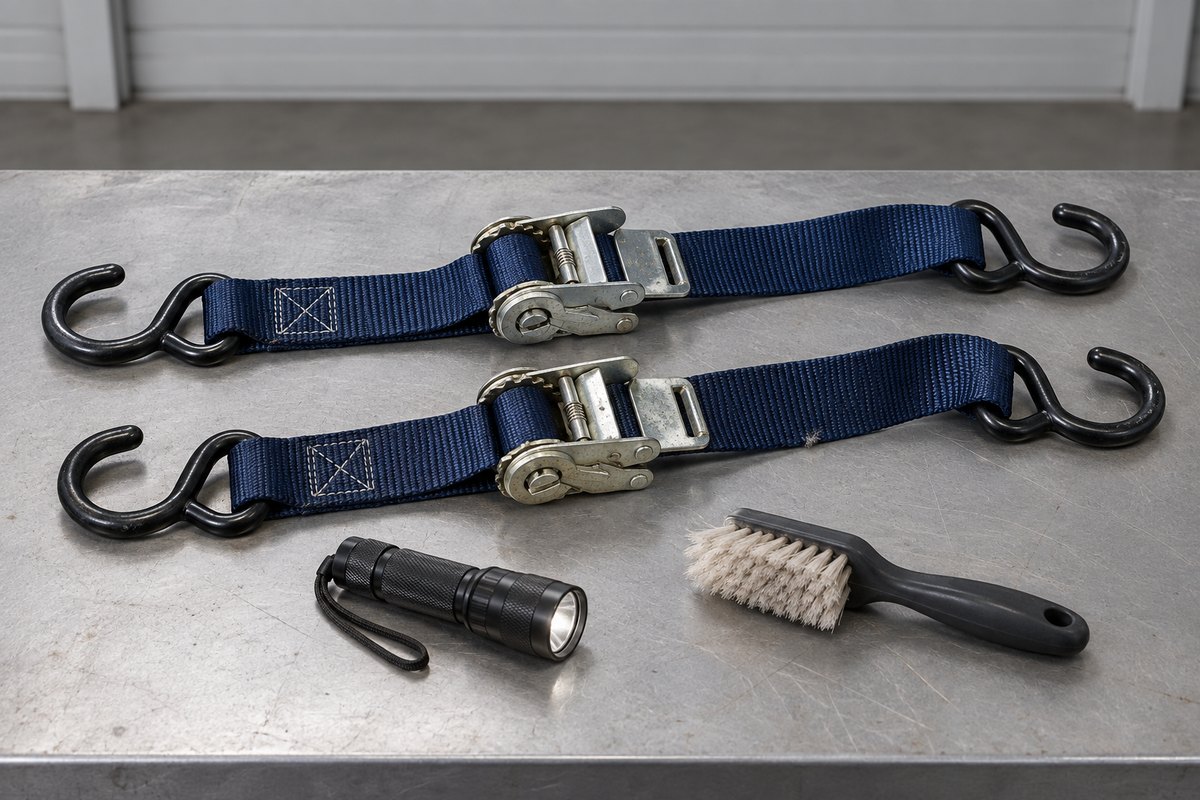
Transom tie-downs may be removable cam-buckle straps, manual ratchet straps, or permanently mounted retractable units. Their capacities, mounting hardware, hook styles, webbing materials, and service instructions differ. Use the label and manual for the exact strap, plus the boat and trailer manufacturers’ approved tie-down points. Never infer capacity from width, color, or how heavy a buckle feels.
Understand why the stern needs separate restraint
The trailer winch pulls the bow toward the bow stop, but it is not the only restraint the boat needs. Load Rite’s owner manual directs owners to secure the boat at both bow and stern with approved tie-downs of appropriate capacity and warns against relying on the winch cable, rope, or strap alone. EZ Loader likewise calls for the stern to be tied down in both a downward and forward direction using the trailer’s rear tie-down points.
That geometry matters. A properly placed transom strap does more than pull straight down. It holds the stern toward its supports and resists fore-and-aft movement. If a strap pulls sideways, rubs a sharp corner, or attaches to an improvised point, the hardware may be loaded in a direction it was not designed to carry.
Remove, rinse, and dry the straps before inspection
Park the trailer on firm, level ground, secure it against movement, and unload tension from each strap before releasing it. Keep control of a ratchet handle and hook as tension comes off; spring-loaded or retractable hardware can move quickly.
After freshwater or saltwater exposure, rinse webbing and metal hardware with fresh water. Extend retractable straps far enough to rinse and inspect the usable webbing, following the manufacturer’s directions. Let everything dry fully before retracting or storing it. Packing wet webbing into a housing or sealed compartment can hide corrosion and mildew.
Do not clean straps with bleach, strong solvent, fuel, or an unapproved lubricant. Chemicals that make webbing look cleaner can reduce fiber strength, and excess oil can attract grit or interfere with a ratchet’s grip. Use the care method specified by the strap manufacturer.
Inspect every inch of the webbing
Run the loose strap through your hands with no load on it, bending it gently to expose both faces and both edges. For a retractable unit, pull out the accessible length and inspect the section that normally remains near the spool as well as the exposed end.
Replace the strap or complete assembly according to the manufacturer if you find:
- A cut, tear, puncture, melted spot, or missing section of webbing.
- Heavy fuzzing, edge abrasion, or fibers worn flat by rubbing.
- Sun-faded, brittle, stiff, or unusually soft material.
- Chemical staining, oily saturation, mildew damage, or heat glazing.
- Pulled, broken, or abraded stitching at a hook or buckle.
- A knot, twist that will not lay flat, or previous field repair.
- A label that is missing or unreadable when it carries the identification or rating needed for safe selection.
Do not stitch, knot, tape, heat-seal, or splice a damaged load-bearing section as a repair. If excess webbing was trimmed previously, verify that the remaining length and finished end comply with the strap maker’s instructions.
Check hooks, keepers, buckles, and ratchets
Inspect each hook under bright light. The hook should not be opened up, twisted, cracked, deeply gouged, or thinned by wear. Check vinyl or rubber coatings for damage that could expose metal to the boat’s transom eye, but do not mistake a cosmetic coating nick for proof that the hook itself is structurally sound.
If the hook has a spring keeper, confirm that it closes freely and seats against the hook. A weak, missing, or jammed keeper can allow an unloaded hook to fall away while the strap is being positioned.
For cam buckles and ratchets, inspect:
- Ratchet teeth for chips, rounding, contamination, or uneven wear.
- Pawls and release levers for full engagement and return.
- Pins, rivets, bolts, and side plates for looseness or distortion.
- The webbing slot and spool for burrs or sharp edges.
- Springs for corrosion, breakage, or sluggish movement.
- Metal surfaces for deep rust, pitting, cracks, or significant section loss.
Operate the unloaded mechanism through its full normal range. It should open, close, lock, and release without forcing. Do not use a hammer or pry tool on a reluctant ratchet. A mechanism that skips teeth, fails to lock, or will not release normally should be replaced or serviced under the manufacturer’s instructions before towing.
Inspect retractable housings and trailer mounts
Permanently mounted retractable tie-downs add a housing, spool, return spring, and trailer attachment point. Check the housing for cracks, impact damage, bent side plates, drainage blockage, and corrosion. The strap should retract smoothly without snapping back uncontrollably, bunching at the slot, or leaving loops inside the housing.
Inspect the mounting bolt, washer, locknut, bracket, and trailer tab. Look for looseness, distortion, elongated holes, cracked welds, and rust trails. Do not drill a new mounting hole or move the unit without approval from the trailer manufacturer. BoatBuckle’s installation instructions specifically tell installers to confirm a safe drilling location with the trailer manufacturer and to align the unit for as straight a pull as possible. Those instructions apply to the covered BoatBuckle models; other products may use different hardware and geometry.
Do not substitute a generic bolt. Match the manufacturer’s required diameter, grade, coating, washer arrangement, locking method, and torque. Over-tightening can deform a hollow trailer frame or the tie-down housing, while under-tightening can let the unit rotate or work loose.
Confirm the strap path and tie-down geometry
With the boat correctly positioned on its bunks or rollers, connect each strap only to approved transom and trailer points. The webbing should lie flat and pull in a direct line without crossing a sharp hull edge, trim tab, exhaust outlet, swim-platform bracket, transducer, light, license plate, or moving trailer part.
EZ Loader calls for the stern straps to pull downward and forward. BoatBuckle instructs owners of its retractable system to swivel the unit before final mounting so the web has a straight-line pull toward the transom eye. Together, those recommendations support a simple inspection question: is the strap applying useful restraint without side-loading the hook or sawing across another component?
Check that the hook seats fully in the eye and cannot bear on its tip. Make sure the hook opening and keeper face a direction that will not allow easy disengagement if the strap briefly loses tension. If a transom eye, trailer tab, or welded attachment point is bent, cracked, loose, or heavily corroded, repair that structure before relying on a new strap.
Use the correct rating and tension
Select straps using the manufacturer’s marked working load information, product instructions, boat and trailer guidance, and applicable towing laws. Break strength and working load limit are not interchangeable terms. Do not combine two undersized straps and assume their ratings can always be added, and do not use an unreadable or unidentified strap for a critical tie-down.
Tighten each side enough to remove slack and secure the stern without distorting the transom eye, trailer bracket, hull, or support system. More ratchet force is not automatically safer. Compare the two sides, then check that the boat remains seated evenly on its bunks or rollers. EZ Loader advises checking support and winch adjustment if a fully tied boat can still rock on the trailer.
After a short initial tow, stop in a safe location and recheck all restraints. Recheck again during longer trips and after rough roads, hard stops, or large temperature changes. Replace any strap that will not hold adjustment.
Prepare transom tie-downs for storage
For removable straps, store them clean, dry, loosely coiled, and away from direct sunlight, batteries, fuel, solvents, sharp tools, and rodents. Avoid a tight knot that creases the same section of webbing for months.
For retractable units, follow the maker’s storage position. Keep the strap clean and dry before it returns into the housing, and protect exposed hooks from resting in standing water. Do not leave a heavily tensioned strap on the boat solely for winter storage unless the boat and trailer manufacturers call for it. Supports may settle and temperatures may change; the storage arrangement must keep the boat safely positioned without using tie-down tension to compensate for poor bunk or roller fit.
Record tie-down maintenance in BoatDuty
Record the inspection date, strap manufacturer and model, marked working load information, length, hook style, mounting hardware, and condition of the webbing, stitching, ratchet, housing, and attachment points in BoatDuty. Note whether the straps were rinsed after saltwater use and which component was replaced.
Detailed notes make replacements easier. “Port strap edge fuzzy for six inches beside trailer light bracket; routing corrected; matched pair replaced” is more useful than “straps okay.” Save the exact replacement part number and installation date so the age and service history are available before the next towing season.
Boat trailer transom tie-down checklist
- Confirm strap identity, rating, length, and manufacturer instructions.
- Release tension safely, then rinse and dry the complete assembly.
- Inspect both faces, edges, and stitching along the full webbing length.
- Check hooks, keepers, ratchets, pawls, pins, springs, and release levers.
- Inspect retractable housings and trailer mounting hardware where fitted.
- Verify approved transom and trailer attachment points.
- Confirm a flat, direct strap path with no sharp-edge contact.
- Replace damaged, unidentified, or unreliable components before towing.
- Recheck tension after the first short tow and during long trips.
- Record ratings, parts, findings, and replacement dates in BoatDuty.