

Boat livewell winterization deserves more attention than simply pulling a drain plug. A typical livewell may contain an intake pump, recirculation pump, pump-out circuit, control valve, spray head, drain, overflow, check valve, hoses, and several low spots where water can remain after the tank looks empty. In freezing weather, that trapped water can expand and damage a pump housing, fitting, valve, or hose connection.
The right procedure depends on how the boat was built. Some livewells drain completely by gravity; others need compressed air, pump operation, or a manufacturer-approved propylene-glycol solution to protect low points. Start with the boat owner’s manual and the manuals for the installed pumps and valves. If those instructions differ from general advice, follow the equipment manufacturer.
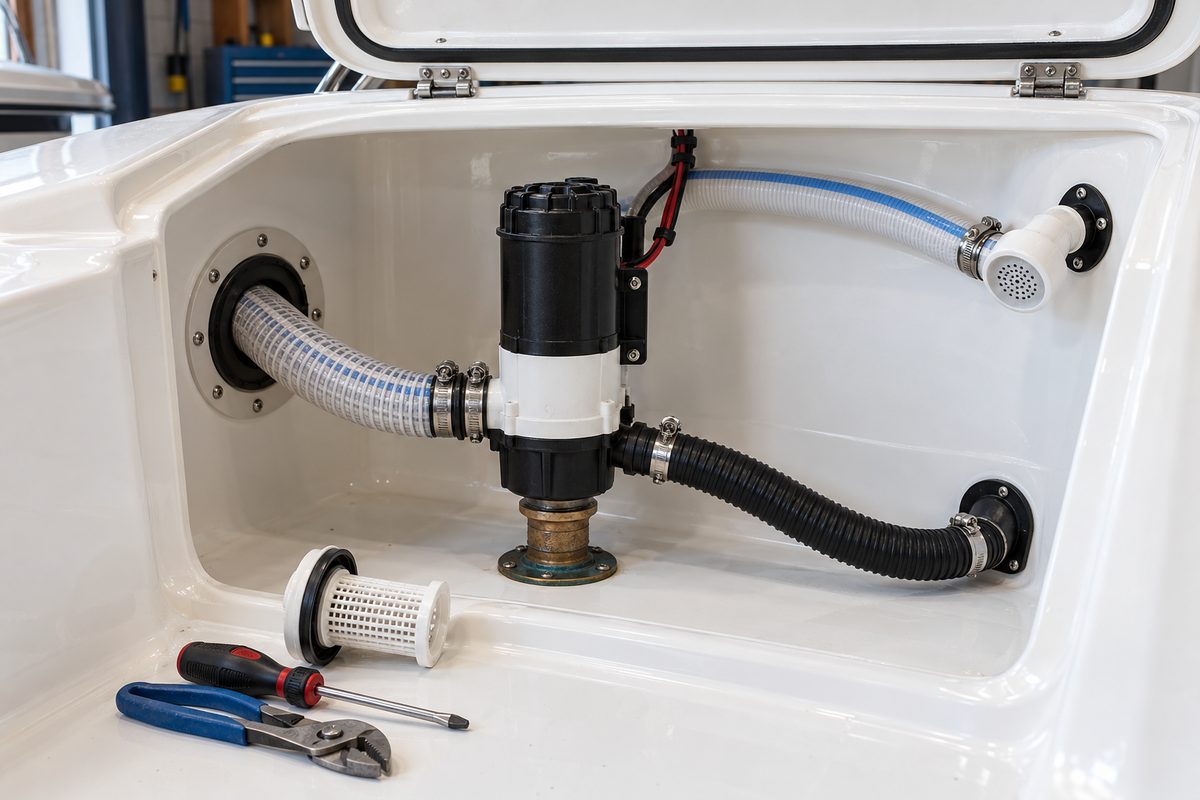
Know Which Livewell System You Have
Before disconnecting anything, trace the system from the outside of the hull to the tank. Not every boat has every component, and a single boat may have separate forward and aft livewells.
Common components include:
- a screened through-hull or transom pickup;
- a seacock or shutoff valve on below-waterline installations;
- a cartridge-style aerator or fill pump;
- a selector valve with positions such as fill, auto, recirculate, or empty;
- a recirculation pump and spray head;
- a pump-out valve or dedicated pump;
- an overflow or standpipe;
- a drain hose, often with a low section hidden below the tank; and
- wiring, switches, timers, fuses, and connectors.
Operate the controls while the boat is still in service and label anything that is unclear. Photographs of hose routing and valve positions are useful when spring recommissioning arrives.
Start With Safety and Access
Haul the boat or follow the builder’s approved method before opening a below-waterline circuit. Turn off the livewell switches and isolate electrical power at the appropriate breaker, fuse, or battery switch. Ventilate the work area and make sure the boat is supported safely.
Never remove a pump cartridge from a through-hull installation without first closing and securing the seacock or otherwise blocking the opening exactly as the pump manufacturer directs. The Rule Tournament Series manual specifically warns that the through-hull must be blocked before cartridge removal and that the cartridge must be fully locked when the boat is in the water. If the shutoff valve is stiff, corroded, or inaccessible, stop and have the system serviced before launch.
Clean the Tank Before Draining the Plumbing
Organic residue, scales, weeds, sand, and forgotten bait can create odor and clog a screen or spray head during storage. Skeeter’s owner guidance calls for rinsing the livewell and baitwell after use. For seasonal layup, clean more deliberately:
- Remove fish, bait, loose tackle, drain plugs, and standpipes.
- Rinse loose material toward the drain while it is still open.
- Clean the tank with products and concentrations approved by the boat builder. Avoid a chemical that could harm fish, plastic, sealants, pump parts, or the environment.
- Remove and clean accessible intake screens, strainers, and spray-head screens.
- Rinse thoroughly until no cleaner or debris remains.
- Leave the tank open long enough to dry.
Do not push debris deeper into a hose. If a drain runs slowly, inspect the hose and fitting instead of relying on more pump time or higher air pressure.
Put Every Valve in Its Drain Position
Remove the drain plug or standpipe and set the livewell controls to the position specified for complete drainage. Ranger’s owner guidance says livewell valves should be placed in the empty position so the plumbing can drain. A valve left in recirculate or retain can isolate a hose full of water even when the tank itself is empty.
Check each well separately. Open adjustable spray heads, pump-out nozzles, and any manual valves the owner’s manual identifies. Raise or lower the bow only if the builder’s procedure calls for it and the boat remains safely supported.
Watch every outlet. A weak trickle, delayed drainage, or water returning to the tank can point to a kinked hose, blocked fitting, failed check valve, or incorrect valve position.
Remove Water From Pumps and Low Hoses
The winterization method should match the boat and the climate.
Gravity drainage
On a simple system, correct valve positions and open drains may empty the plumbing. Allow enough time for hidden low points to release. Gently reposition flexible hoses only if they are accessible and properly supported; do not pull on fittings or create a new sag.
Compressed air
Lund’s storage guidance says to remove remaining water from livewell hoses and pumps with compressed air at the fittings and drain holes. Use this method only when the boat and component manuals permit it. Use clean, regulated, low-pressure air and an adapter that does not damage the fitting. Keep a discharge path open, never dead-head the system, and never exceed the lowest-rated component. Excess pressure can split a hose, unseat a seal, or damage a pump.
Work one circuit at a time until no water emerges. Do not spin a pump with air or run it dry unless the pump manual explicitly allows that procedure.
Non-toxic antifreeze
Crestliner advises using non-toxic propylene-glycol antifreeze for systems such as livewell pumps when antifreeze circulation is required. Do not substitute automotive ethylene-glycol coolant. Use only a product and concentration approved for the exact system, storage temperature, and materials, and capture the discharge for proper disposal. Do not pump antifreeze overboard.
If the boat builder specifies dry storage instead, do not add antifreeze simply as a precaution. Follow the manual, especially where the livewell shares plumbing with another raw-water system.
Inspect the Pump, Hoses, and Fittings
Once the system is clean and drained, inspect it while access panels are open.
Pump and cartridge
Look for cracks, a loose cartridge, damaged locking tabs, swollen seals, shaft debris, or corrosion at the base. On a removable cartridge pump, follow the exact release and installation procedure. The Rule manual describes pressing the cartridge button, twisting counterclockwise, and pulling straight up; other brands may use a different lock. Never force a cartridge or assume a click means it is seated—verify the alignment marks and full lock described in the manual.
Hoses and clamps
Examine the entire visible length of each hose. Replace a hose that is cracked, cut, abraded, hardened, collapsed, or permanently kinked. Check both sides of each clamp for weeping, rust staining, or movement. A clamp should sit over the fitting’s barb and should not cut the hose. Use replacement hose and clamps that meet the builder’s specification, especially below the waterline.
Valves, drains, and spray heads
Move each control through its full range without forcing it. A stiff cable or valve may need service rather than more leverage. Clean screens and nozzles, inspect O-rings and gaskets, and confirm that a drain plug or standpipe seals without cross-threading. Check the tank around fittings for cracks or movement.
Wiring
Inspect pump wires, waterproof connectors, fuse holders, and switch terminals for corrosion, chafe, loose strain relief, and overheated insulation. Do not probe a sealed connector unnecessarily. Make repairs with marine-rated materials and restore circuit protection to the manufacturer’s specification.
Do a Controlled Function Test
If the builder calls for a test before storage, supply water by the approved method and test each function briefly: fill, aerate, recirculate, pump out, and drain. Never run a livewell pump dry. Observe connections under operating pressure and confirm that water exits through the intended outlet rather than into the bilge.
After testing, repeat the complete drainage or antifreeze procedure. A successful wet test can reintroduce enough water to cause freeze damage if the system is not drained again.
Store the System Open and Dry—When the Manual Allows
Leave drain plugs or standpipes out if the boat builder recommends it, and store them where they will not be lost. Leave the livewell lid slightly open for ventilation only when doing so will not admit rain, pests, or cover runoff. Do not leave a seacock open merely to promote drainage; the correct storage position is boat- and installation-specific.
Keep removed screens and cartridges labeled. If a pump cartridge is stored out of the housing, protect the opening and reinstall it before launch using the manufacturer’s sealing and locking procedure.
Spring Recommissioning Checklist
Before launching:
- reinstall drain plugs, standpipes, screens, and cartridges;
- verify every cartridge lock, hose connection, and clamp;
- return seacocks and valves to the correct operating positions;
- flush out antifreeze and collect it for proper disposal;
- inspect the bilge while filling the livewell;
- test fill, aeration, recirculation, pump-out, and drainage;
- confirm pumps stop and start correctly in manual and timed modes; and
- check below-waterline fittings for leaks before leaving the dock.
If the pump runs but flow is weak, shut it down and check the intake screen, valve position, air lock, voltage, hose routing, and spray head. Do not keep a dry or blocked pump energized.
Record the Work for Next Season
A useful livewell record includes the service date, storage temperature assumption, winterization method, valve positions, antifreeze product and concentration if used, pump model, fuse rating, hose or clamp replacements, and any slow-drain or low-flow symptoms. Add photos of the final hose routing and valve settings.
BoatDuty can keep that information with the rest of the boat’s maintenance history. A brief entry now makes it easier to reverse the layup correctly in spring and helps recurring problems—such as a hose that repeatedly traps water or a pump that draws excessive current—stand out over time.
Sources
- Lund Boats, Owner’s Manual (livewell operation and storage guidance)
- Ranger Boats, Owner/Operator’s Manual (livewell plumbing and empty position)
- Xylem Rule, Tournament Series Livewell/Baitwell Pumps Instruction Guide (cartridge service and through-hull warnings)
- Crestliner, “9 Boat Winterizing Tips from the Experts” (propylene-glycol guidance for livewell and washdown systems)
- Skeeter Boats, 2022 Freshwater Owner’s/Operator’s Manual (livewell cleaning and system-specific operation)